
Come and explore the societal and environmental risks of being (“ser” in Spanish) AI users!
How is that AI usage is affecting democracies? What about its effects on human cognition? What are the environmental costs of using it?
We are looking forward to welcome you for an afternoon full of insights from VU researchers about the risks of AI use and current ongoing works, where you also will have the opportunity to do hands-on activities during the workshop session and to showcase your own research.
📍 Location: Vrije Universiteit Amsterdam (VU), the Netherlands
📅 Date: November 12, 2026
🕐 Time: 13:00–18:30
👉 Register here: https://forms.office.com/e/1rVs1XVs7R
🌐 Webpage: https://sites.google.com/vu.nl/ser-ai
The itinerary is still preliminary and may be subject to changes
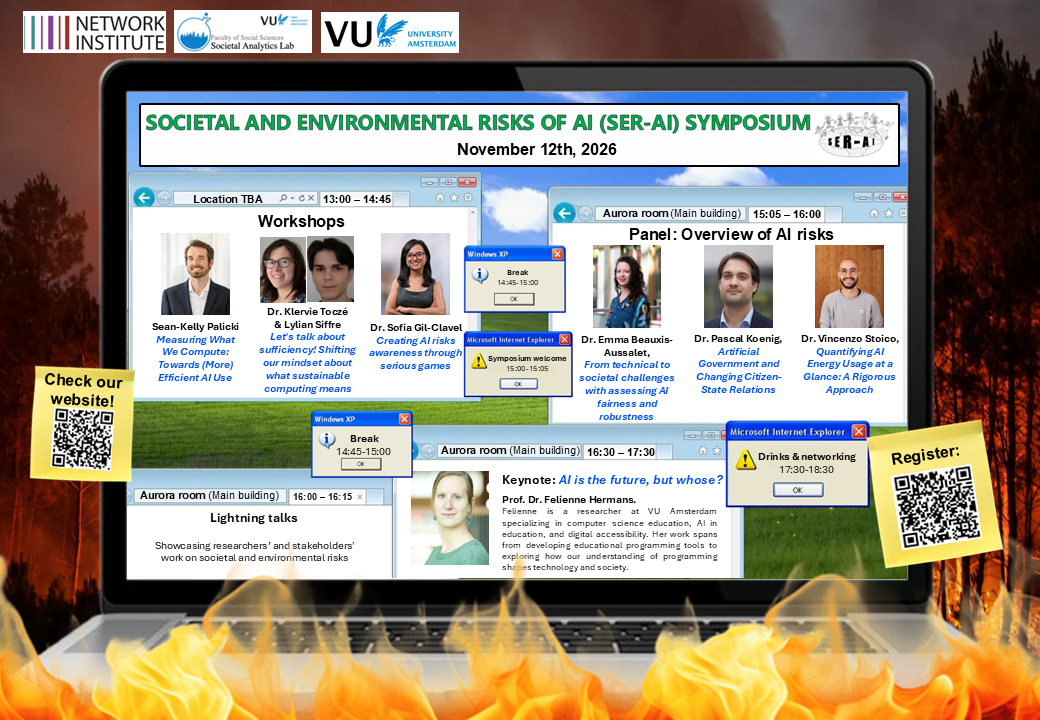
13:00-14:45: Workshops (parallel sessions - location will be communicated to registered participants):
- Measuring What We Compute: Towards (More) Efficient AI Use by Sean-Kelly Palicki
- Let’s talk about sufficiency! Shifting our mindset about what sustainable computing means by Dr. Klervie Toczé and Lylian Siffre
- Creating awareness of AI risks through serious games by Dr. Sofia Gil-Clavel
14:45-15:00: Break
Main session (Location: Aurora, VU Main Building)
15.00-15.05: Symposium welcome
15:05-16.00: Panel: Overview of the societal and environmental risks of AI.
- Dr. Emma Beauxis-Aussalet, Department of Computer Science
- Dr. Pascal Koenig, Department of Political Science and Public Administration
- Dr. Vincenzo Stoico, Department of Computer Science
Moderated by Sofia Gil-Clavel.
16:00-16:15: Lightning talks: Showcasing researchers’ and stakeholders’ work on societal and environmental risks of AI
16:15-16:30: Break
16:30-17:30: Keynote: Prof. Dr. Felienne Hermans Title: AI is the future, but whose? Abstract: What is AI? What is AI for, and what are its goals? Can we use AI for science? For education? The dominant discourse in 2026 makes it easy to believe in 2026 that AI is good, and will make our lives and jobs much easier. In this talk Felienne Hermans, professor of Computer Science education will take you through an alternate history of AI, programming and its epistemological development. She will take you through over a century of alternative tech voices, and discuss what we can learn from that for the current state of programming and its future.
17:30-18:30: Drinks and networking
`